C - Product history
Contents :
C-1 - 1930-1936 : the launch
C-2 - 1936-1940 : the expansion of the range
C-3 - 1940-1945 : the crisis
C-4 - 1945-1949 : tidying up
C-5 - 1949-1958 : the revolution
C-6 - 1958-1967 : product and marketing innovations
C-7 - 1967-1977 : the Robert Tchertoff era
C-8 - 1977-1988 : the Mettoy years
C-1 - 1930-1936 - The launch
A photograph of Établissements Vera’s first stand at the Lyon Fair in November 1934 gives an excellent insight into their very first products:

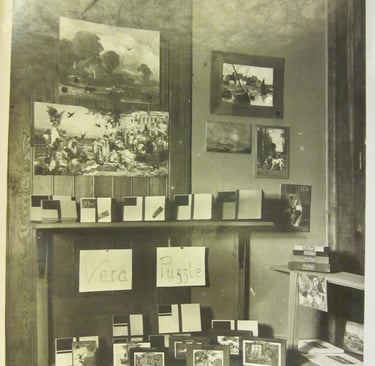
"Stand Vera - Foire de Lyon 1934" - Centre de Documentation du Musée des Arts Décoratifs - Paris
Five different models are on display. The very first items were produced at 395 Rue de Vaugirard (1930–1931), then at 5 Rue Auguste-Vitu (or 5, R. A. Vitu). The first items produced at Rue Auguste-Vitu (1931–32) were numbered, but this practice was soon discontinued. For further details, please refer to the relevant sections. The five brands selected for production are:
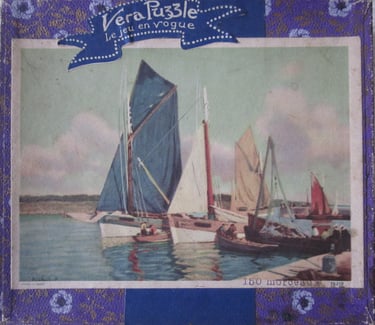
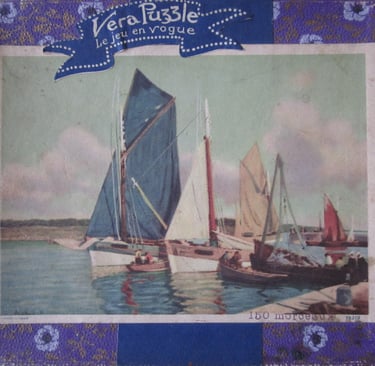
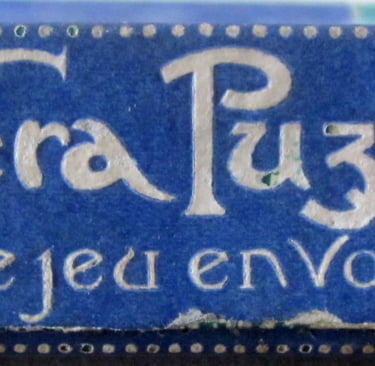
‘Vera Puzzle Le Jeu en Vogue’: jigsaw puzzles aimed at children and adults: the image appears on the lid of the box. The boxes come in different colours with colourful floral patterns, and the cut-out design was very minimalist at the start of the series; for example, pieces were frequently cut into two parts. The banner on the top of the lid disappeared in 1939.
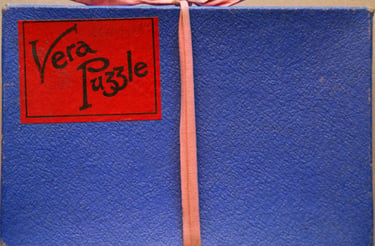
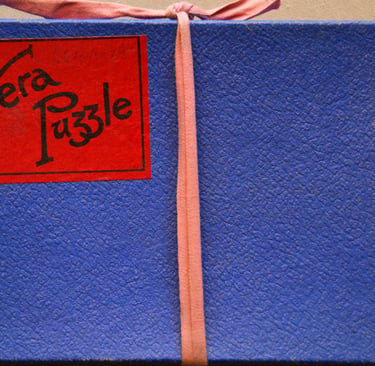
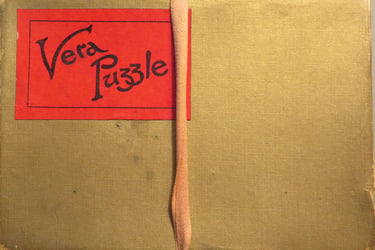
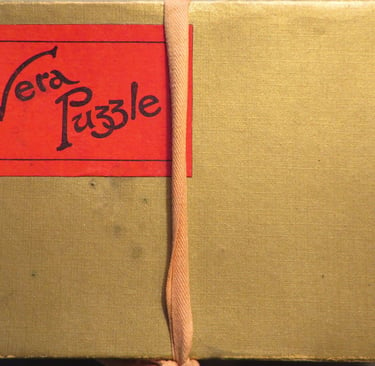
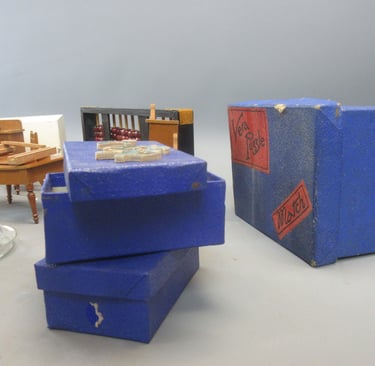
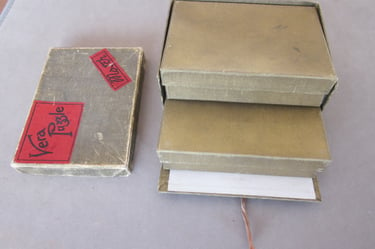
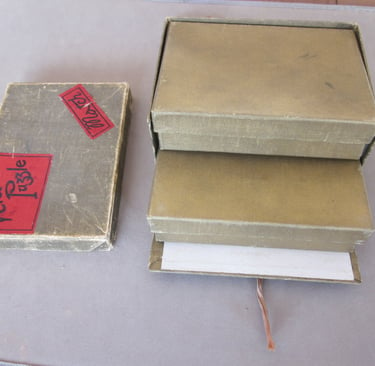
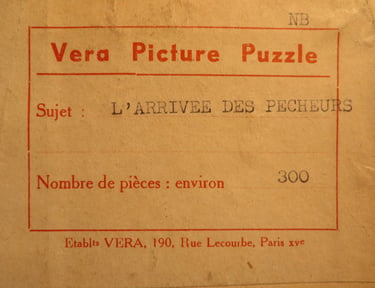
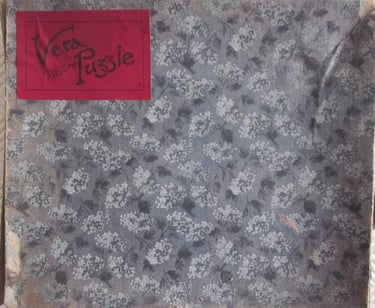
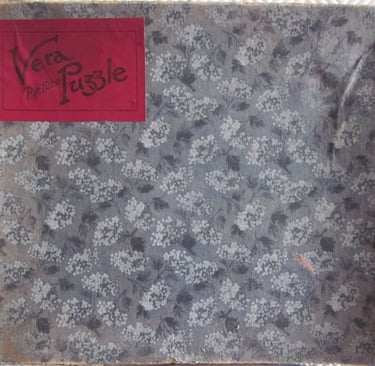
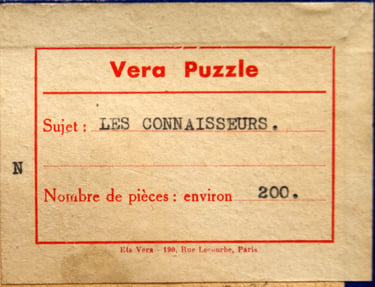
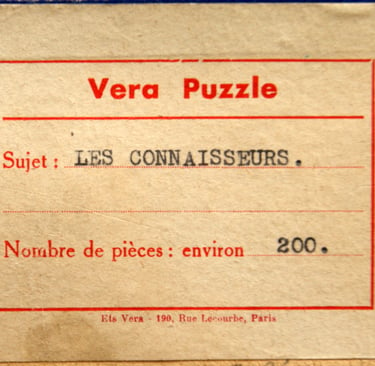
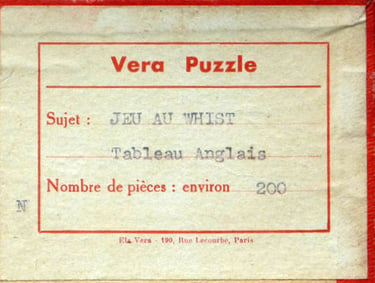
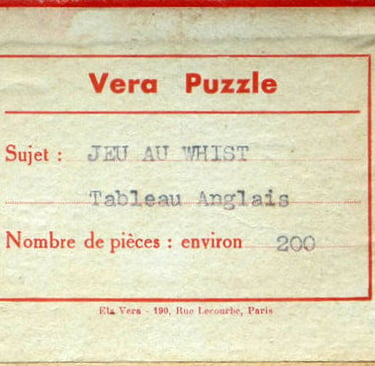
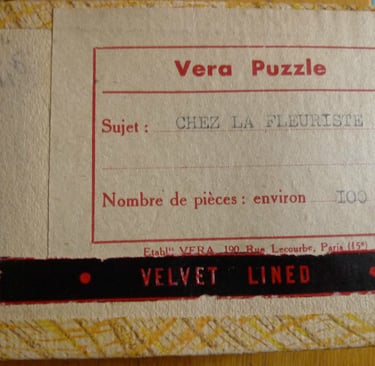
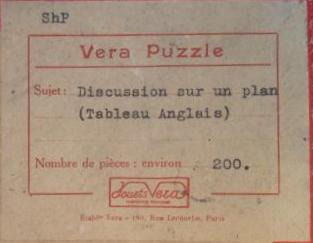
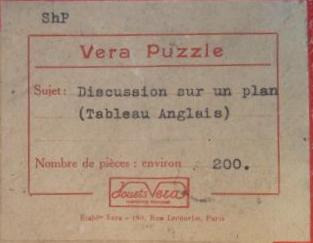
‘Vera Puzzle’: a range of jigsaw puzzles for adults: they come in blue or gold boxes with a ribbon around them and a label on the top left of the lid. This packaging design remained consistent throughout the company’s existence. The logo is set within a red rectangle reading “Vera Puzzle”. The label on the back is very simple: “Vera Puzzle – Subject: ............... – Number of pieces: approximately ..............”. This range is available in two versions:
blue box: the cut-out is round and does not follow the coloured lines
gold box: unlike the puzzles in the previous series, the cut-out follows the coloured lines and is significantly more sophisticated, featuring whimsical pieces (whimsies)
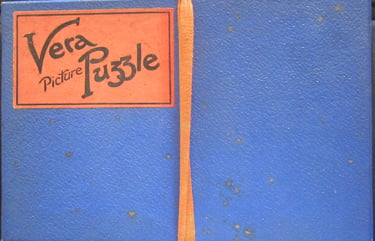
‘Vera Picture Puzzle’: a range which is also available in two different models:
a blue box for products manufactured under contract for Vuitton and for export to English-speaking countries – the cut-out is simple and classic, and the edges interlock
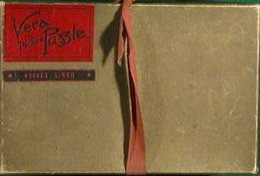
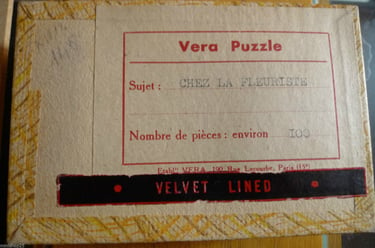
a gold box with a red label on a black background marked “Velvet Lined”, which is much more elaborate: the cut-out follows the coloured lines, featuring whimsical details, and the back of the puzzle is lined with velvet; these products are intended for an Anglo-Saxon clientele. The ‘Velvet Lined’ label indicates that the back of the jigsaw is covered with velvet paper, making the task more challenging for the player, who cannot use the wood grain to help complete the jigsaw:
"Velvet Lined" : see above
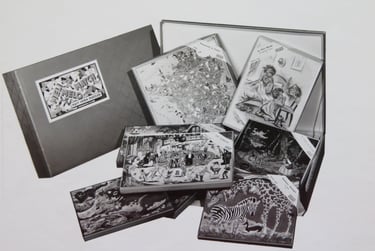
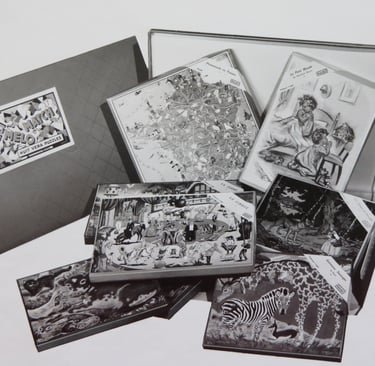
"Match" : A set comprising 2, 3, 4 or 6 jigsaw puzzles in the same box, allowing players to compete to see who can complete them the fastest. It is sold under the Vera Puzzle brand
blue box associated with the ‘Match’ brand. These puzzles come in individual boxes, which are in turn stored in a larger box:
gold box associated with the ‘Match’ brand: same as above but with cut-outs along the coloured lines
Some products sold to specialist retailers have the address crossed out on the label on the back
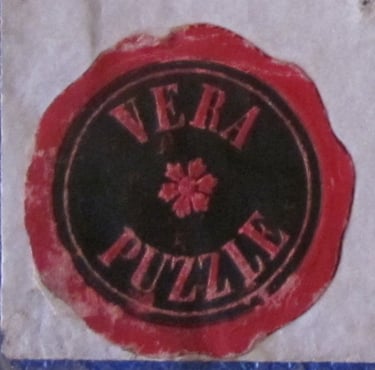
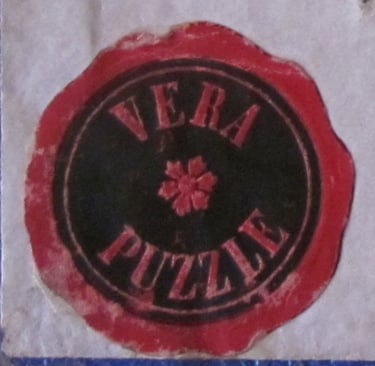
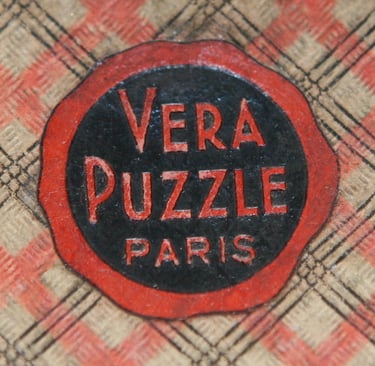
Until 1936, the company used a round red and black ‘Vera Puzzle’ logo on certain products:
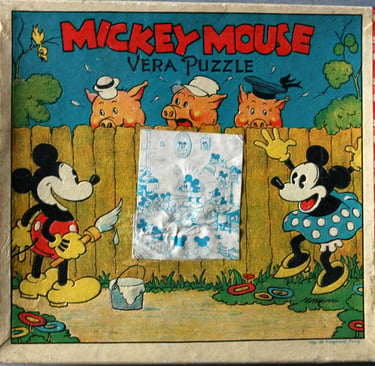
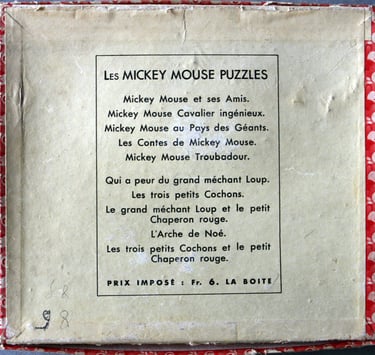
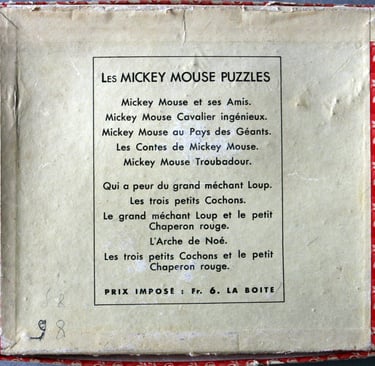
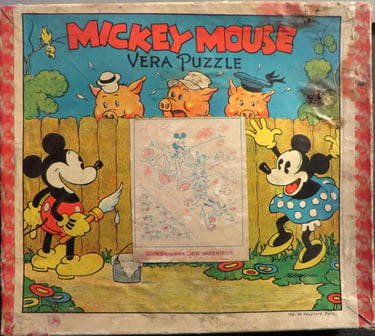
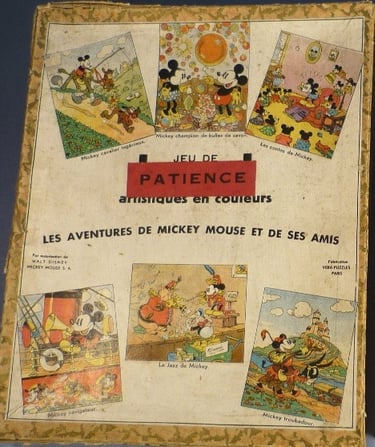
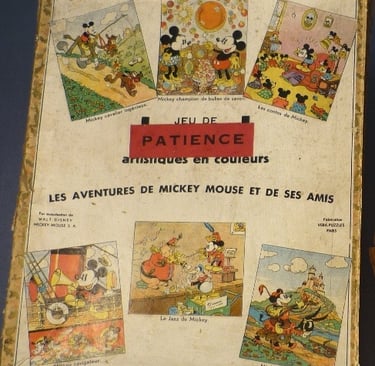
Following the signing of the agreement with Kay Kamen (Walt Disney's agent) in 1934, the first children’s jigsaw puzzles appeared, comprising an initial series of 10 puzzles featuring reproductions of Walt Disney characters in a range called “Mickey Mouse – Vera Puzzle”. The box is red with white markings and features an image stuck onto the lid: Mickey and Winnie in front of a fence, above which "the Three Little Pigs" can be seen. The black-and-white image of the jigsaw is stuck onto the lid without any further details. The address ‘5 rue Auguste-Vitu’ is visible at the bottom on the side. The cut-out design of the pieces (ranging from 70 to over 80 depending on the model) is very simple, with some pieces cut in half, making assembly very difficult. The cutting style is very similar to that of the ‘Vera Puzzle Le Jeu en Vogue’ series. To make it easier for children to use, production switched in 1935 to versions with 48 to 62 pieces, featuring a colourful box in black and burgundy:
Educational games first appeared in the range in 1935 with the first map of France under the ‘Vera Picture Puzzle’ brand:
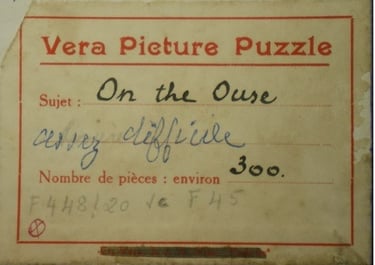
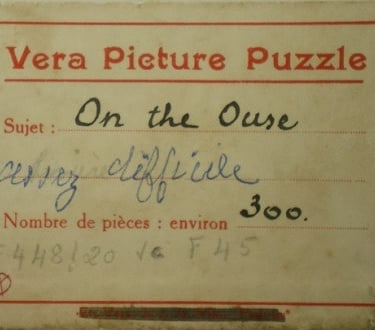
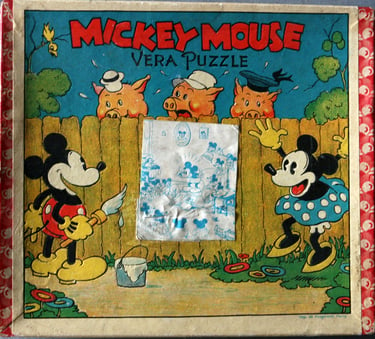
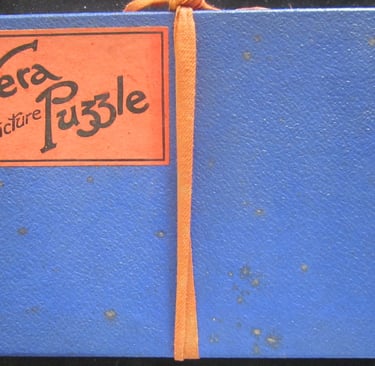
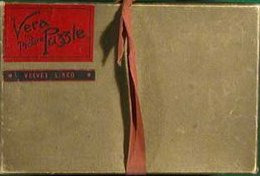
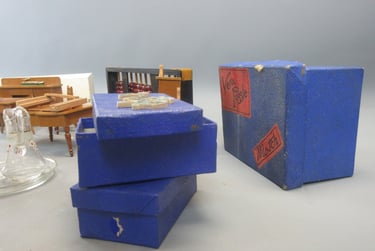
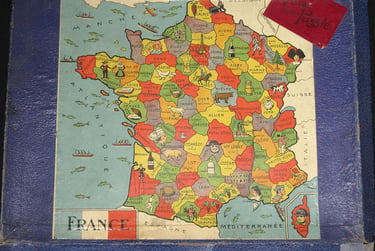
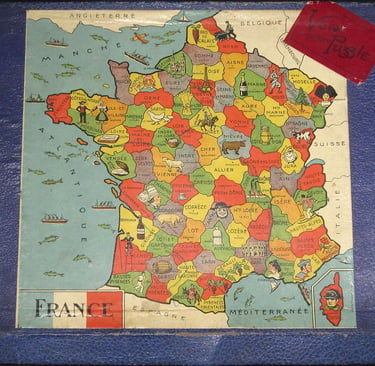
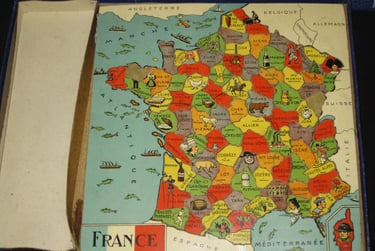
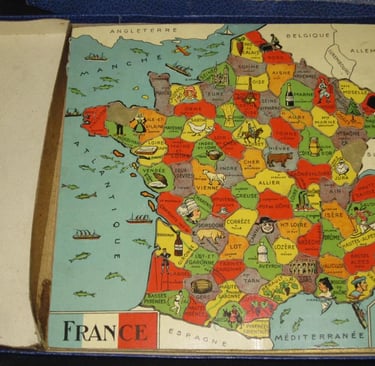
"France" - Vera Picture Puzzle -boîte 34*27 - puzzle 26*26 - 1935 - vu sur eBay
The first models with multiple panels were produced to capitalise on current events in 1935:
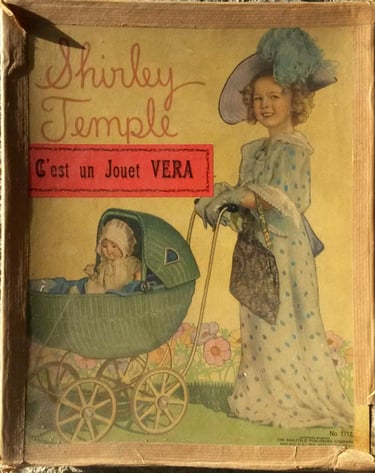
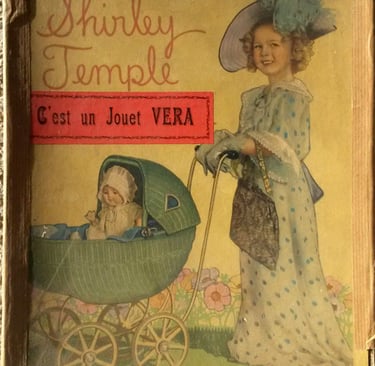
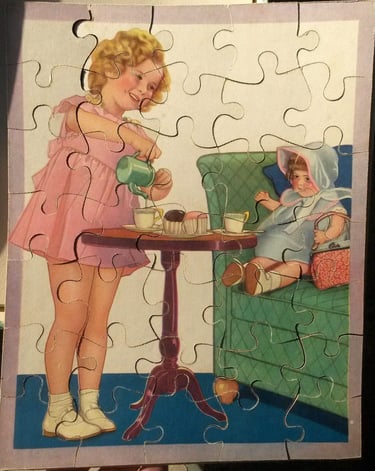
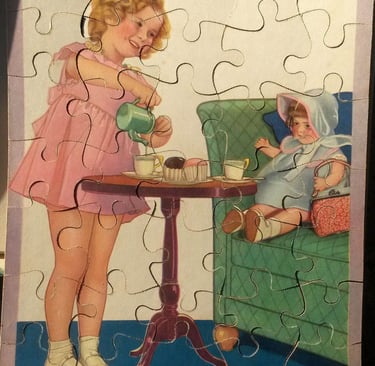
"Shirley Temple at Play" - 35 p. - 4 pl. - 26*33 - 1935 - collection privée
C-2 - 1936-1940 : the expansion of the range
The round ‘Vera Puzzle’ logo was replaced in 1936 by this version::
Following the move, all addresses are now at 190 Rue Lecourbe, Paris
From 1936 onwards, for jigsaw puzzles aimed at adults (the ‘Vera Puzzle’ and ‘Vera Picture Puzzle’ ranges in blue and gold boxes), letters were printed on the label on the back of the box and could have two different meanings:
to identify the person responsible for cutting out the puzzle – the code is often stamped onto the left-hand side of the label, but can also be found in the bottom right-hand corner
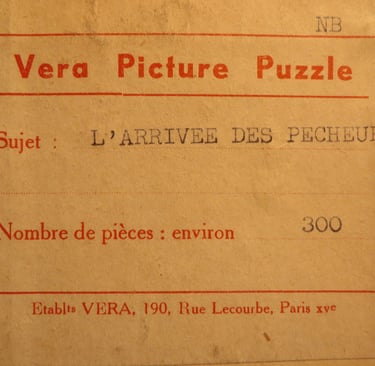
or, in the case of special orders, to indicate the retailer’s name – the code is usually displayed in the top right-hand corner (see example below with ‘NB’ for the shop ‘Au Nain Bleu’)
See the section for the letters recorded to date:
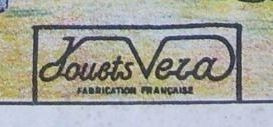
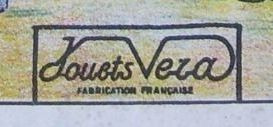
The ‘Jouets Vera – Made in France’ logo first appeared around 1937–38:
Vera’s product range is beginning to expand and diversify:
as regards the products in the “Mickey Mouse – Vera Puzzle” range, produced under licence from Kay Kamen (Walt Disney), the range expanded to 14 designs, and the puzzle title appeared on the black-and-white image affixed to the top of the lid; the number of pieces continued to decrease to make assembly easier for children (and to reduce production costs…)
43 to 57 pieces until 1938 – red box with white markings
40 and 42 in 1938 – plain-coloured box; the labels stuck to the lid now bear the name of the puzzle
12 in 1939:
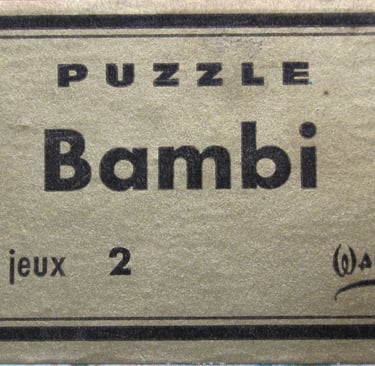
Other Disney characters made their debut: Donald in 1937, Snow White and the Seven Dwarfs in 1938, Pinocchio in 1939, and Bambi in 1940
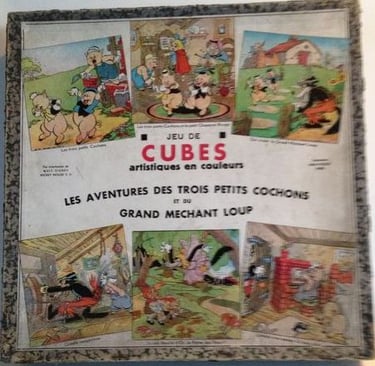
The company developed a range of cubes in boxes containing 25 and 36 cubes:
It is simultaneously launching boxes of six puzzles with the same packaging as the previous one – the only difference is a red label stuck on the lid, covering the word ‘Cubes’:
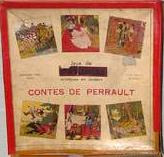
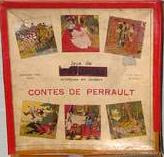
In 1937, Vera commissioned Boris Zvorykin to produce six gouache drawings, intended solely to illustrate wooden jigsaw puzzles based on Perrault’s fairy tales:
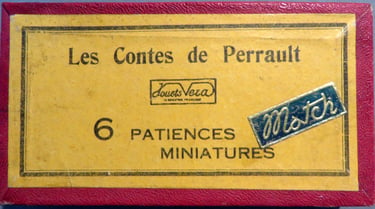
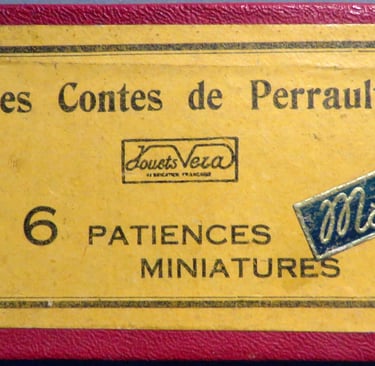
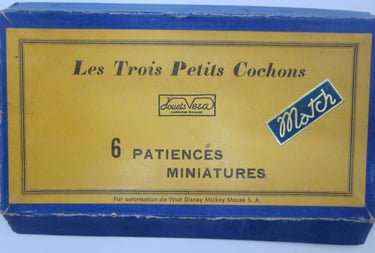
From 1937–38, Vera developed a ‘Puzzles Miniatures’ range featuring the ‘Match’ logo; this range comprised several titles in 2- or 6-sheet formats, generally consisting of 12 pieces each. Snow White and Perrault’s Fairy Tales were thus launched. The name “Puzzles Miniatures” was used for products manufactured up until 1940–45. It was then changed to “Patiences Miniatures” in 1945:
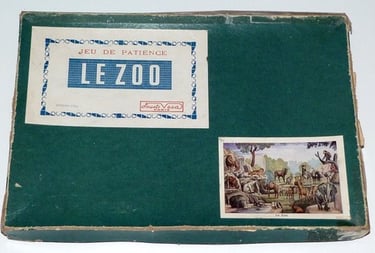
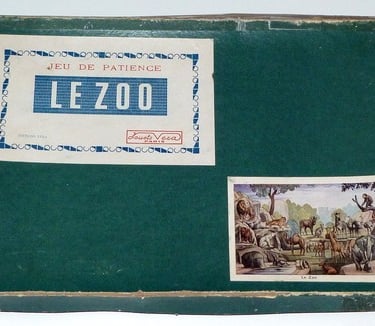
It pursues educational objectives with the series “The Zoo, the Circus, the Farm”; these three models will be numbered 40 to 42 in the classification system established in 1949–50 by Alexandre Tchertoff:
She uses a variety of themes in a series called ‘Petites Patiences’ – this series will become number 1 in the future classification:
The “Vera Puzzle” and “Vera Picture Puzzle” ranges are being expanded with new designs
for children under the “Vera Puzzle” brand, featuring adaptations of Perrault’s fairy tales:
Still aimed at children, and under the ‘Vera Puzzle’ brand, Vera also created an innovative product in this range, which was very quickly discontinued due to high manufacturing costs; it was a jigsaw puzzle featuring specially cut-out figures that could be placed on stands sold alongside it:
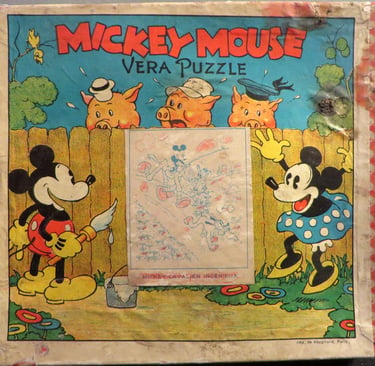
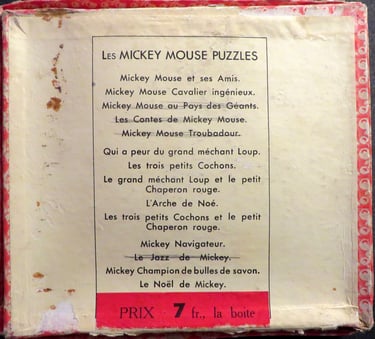
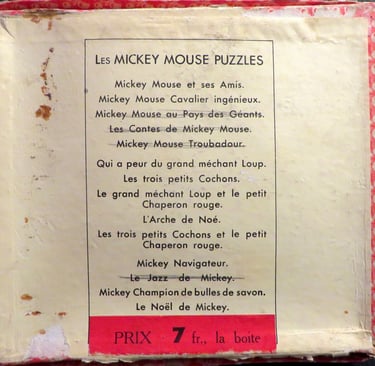
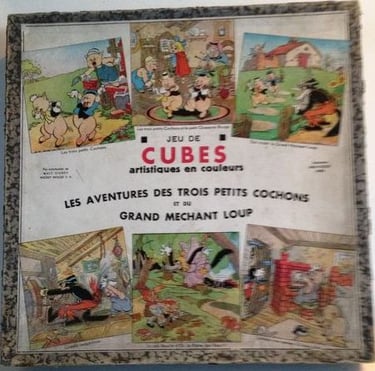
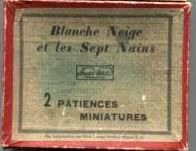
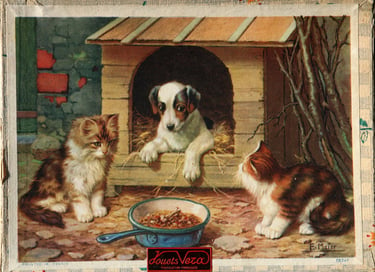
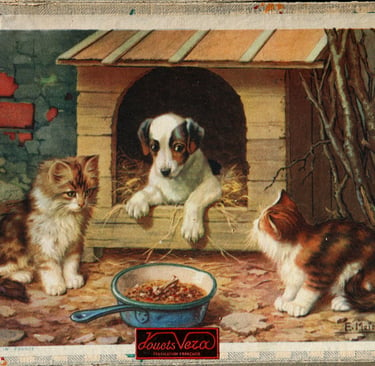
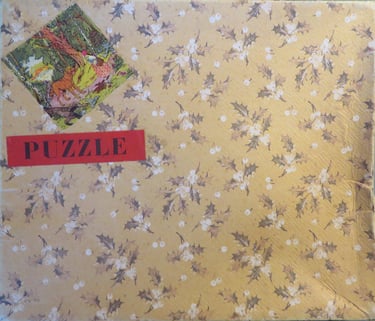
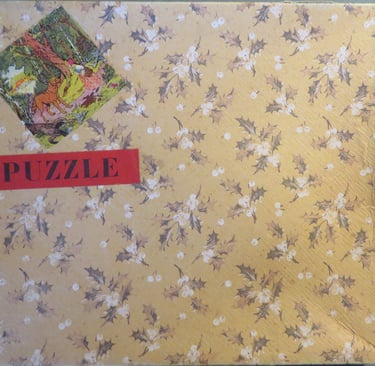
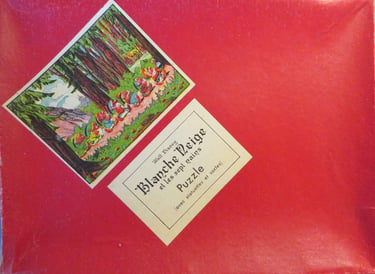
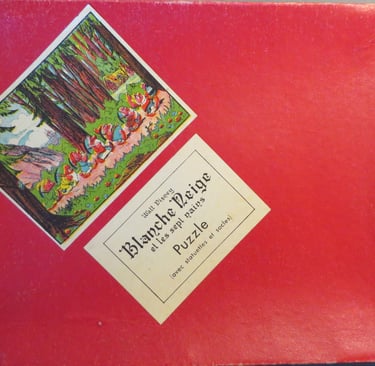
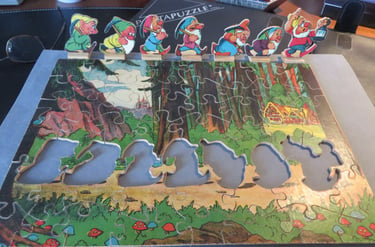
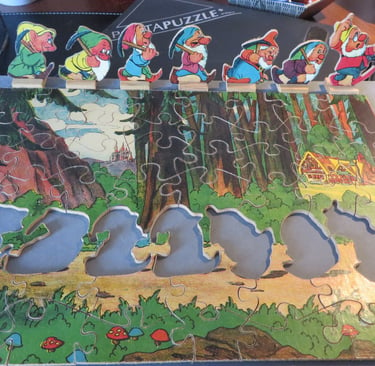
"Blanche Neige et les Sept Nains" - 55 p. - 7 figurines et 7 socles - 31.5*23 - 1937 - Vera Puzzle - collection privée
For adults, a new series has been added to the “Vera Picture Puzzle” range, presented in a colourful box and featuring a puzzle consisting exclusively of loop shapes:
For adults, too, a new range has been added to the “Vera Puzzle” collection, featuring boxes in very distinctive shapes and colours, and a simpler cut-out design (cut into strips and loops) – the production of products specifically for export comes to an end with this range:
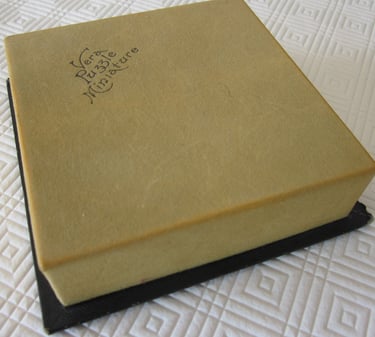
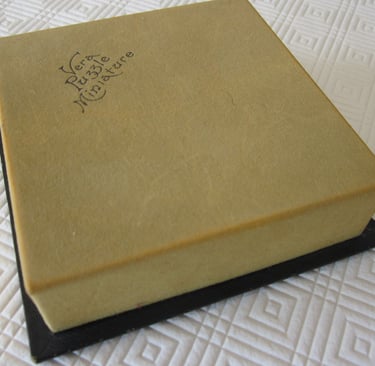
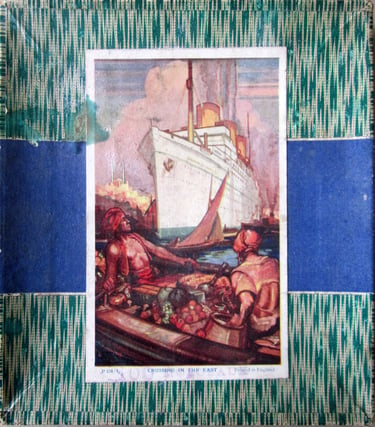
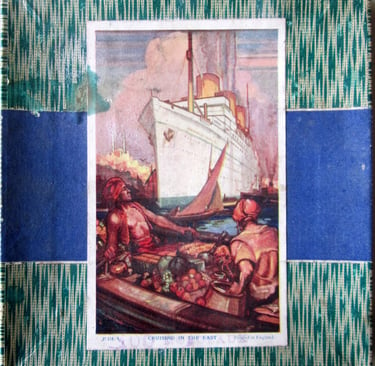
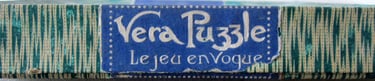
Launch in 1937–38 of the “Vera Puzzle Miniature” range (which would later become No. 32), the first versions of which were made from galalith. The box lid is made of cardboard covered with a flocked finish that imitates velvet. The series comprises boxes containing between 100 and 800 pieces. The “Vera Puzzle Miniature” logo follows the same design as the other Vera Puzzle and Vera Picture Puzzle logos:
The packaging for the “Vera Puzzle le Jeu en Vogue” range changed in 1938–39:
Educational games also expanded, with the first jigsaw puzzle featuring a foreign country, Belgium – see the ‘Codification’ chapter;
the first set of nesting cubes appeared in 1938; a set of musical cubes was also introduced into the range around 1939;
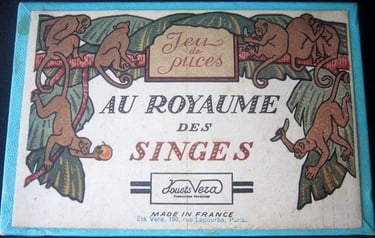
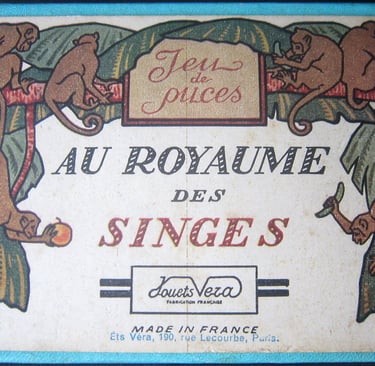
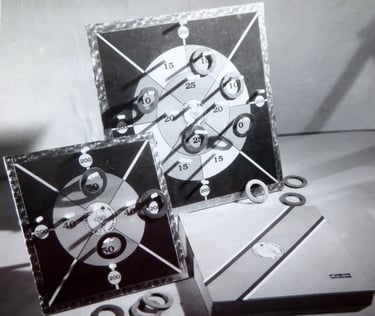
Vera also launched board games and mechanical toys: a jumping-frog game called ‘Au Royaume des Singes’ in 1935, a game of skill in 1938 called ‘Le Discobole’, and a mechanical car called ‘Spiro – La Voiture Obéissante’:
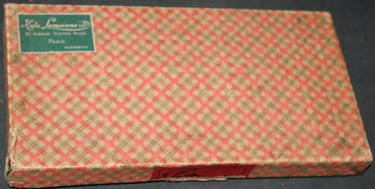
During this period, Vera developed partnerships with luxury companies from various countries, using bespoke packaging (see the relevant sections in the ‘Partners’ chapter):
British: Mappin & Webb, Truslove and Hanson, The Sheffield Plate Co and Whiteleys
American: Brentano’s and City of Paris in San Francisco
French: Lemaire and Louis Vuitton
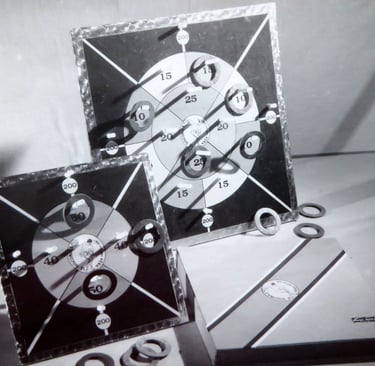
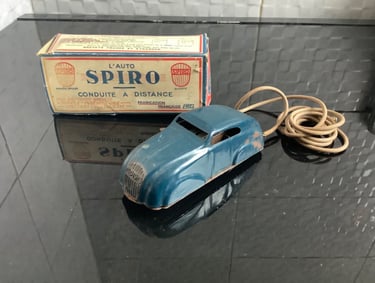
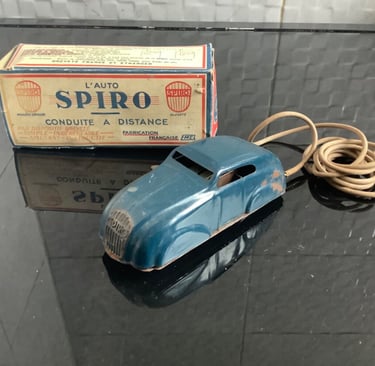
C-3 - 1940-1945 : the crisis
With France’s entry into the Second World War, Vera reduced its range of jigsaw puzzles but developed a whole range of games intended mainly for soldiers on the front line – see the chapters on these topics.
During the Second World War, the logo changed, no doubt under the influence of the management appointed during that period; it became ‘Jeux Vera’. The design became more rounded, the wood was of poorer quality, and the glue didn’t hold… The poor supply conditions were evident in the finish.
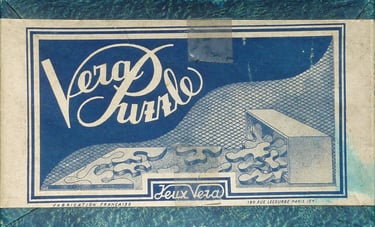
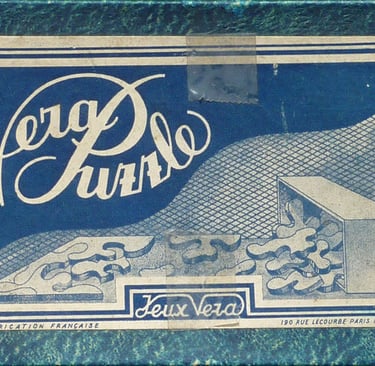
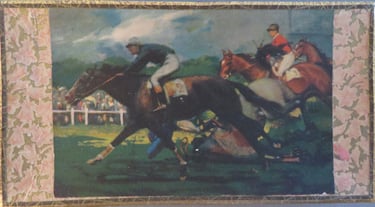
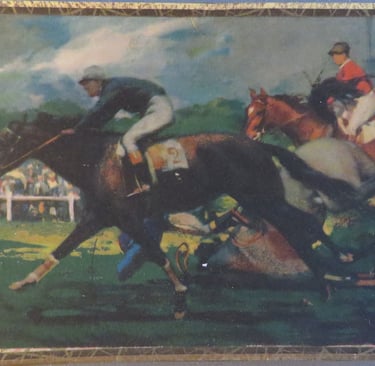
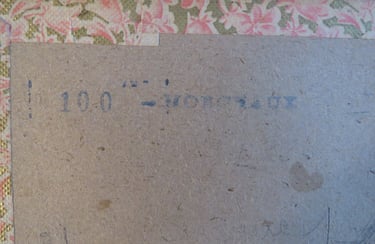
The “Vera Puzzle” and “Vera Picture Puzzle” ranges appear to be disappearing. The adult versions come in blue boxes bearing the “Vera Puzzle” logo, in which the V and P are intertwined; the pieces are rather crudely cut into strips, and the wood is of poor quality; these jigsaw puzzles are clearly produced as cheaply as possible and under the difficult conditions one might imagine. The logo reads ‘Jeux Vera’, and the address is 190 Rue Lecourbe, Paris:
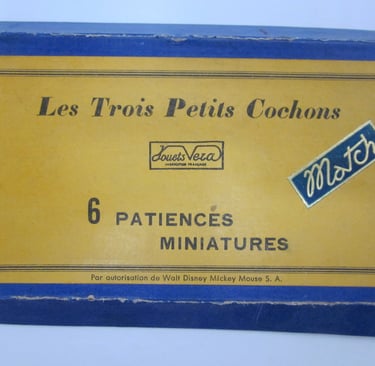
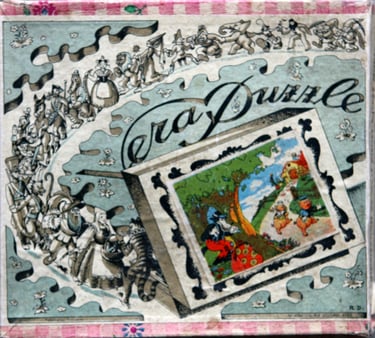
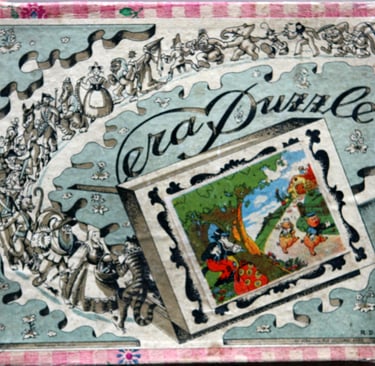
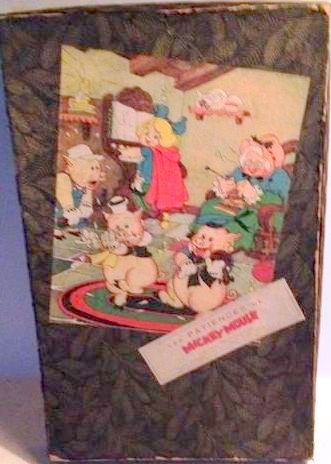
Walt Disney puzzles, Perrault’s Fairy Tales and The Three Little Pigs are packaged in boxes with a red-and-white Vichy-style chequered pattern; the ‘Vera Puzzle’ logo features the letters V and P joined together; the wood is thick (6 mm) but of poor quality. The frame features a print depicting a circle of characters from fairy tales and legends. The address is 190 Rue Lecourbe, Paris:
Replacement of the “Vera Puzzle Le Jeu en Vogue” range for juniors:
Between 1940 and 1943, “Vera Puzzle Junior” jigsaw puzzles came in rather plain boxes, with the number of pieces stamped on the back of the box. The cut-outs consisted exclusively of loops:
Between 1943 and 1945, the ‘Junior Vera Puzzle’ packaging became even more minimalist, and the puzzle sizes were no doubt adapted to suit the materials available:
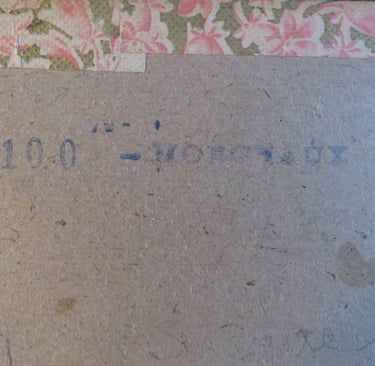
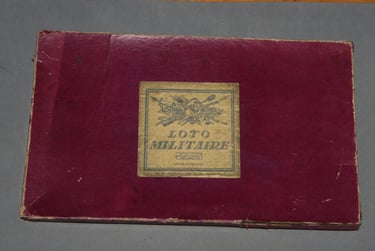
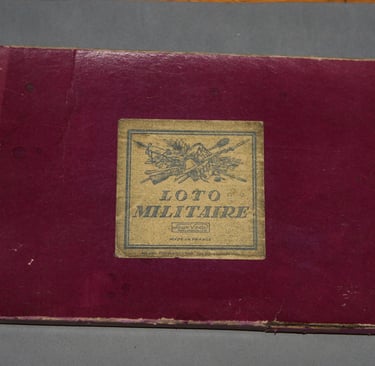
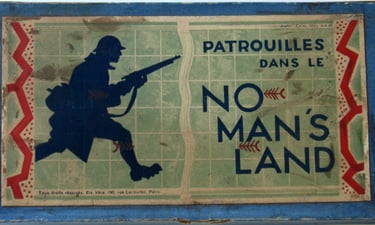
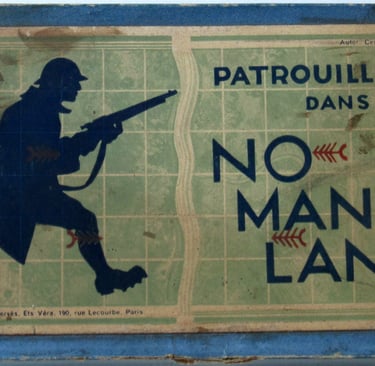
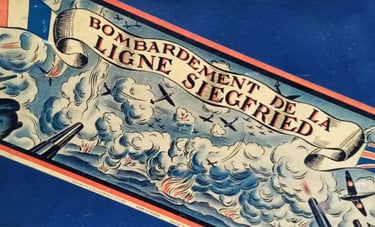
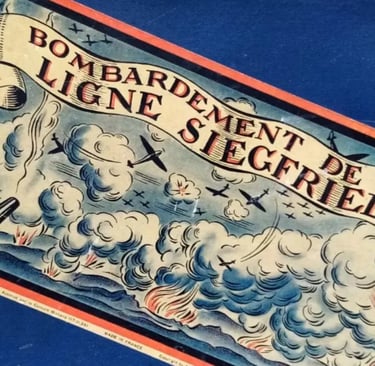
The company is making a significant effort to produce games designed to support the war effort and provide entertainment for soldiers. It therefore produces card games and board games (Lotos, “Patrols in No Man’s Land”, “Bombing of the Siegfried Line”, etc.), always taking care to have its products approved by the military authorities:


C-4 - 1945-1949 : tidying up
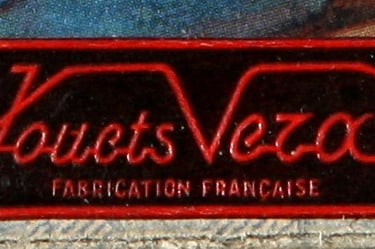
In 1945, following the return of Alexandre Tchertoff, the company undertook a major reorganisation of its manufacturing and marketing operations; the ‘Jouets Vera Fabrication Française’ logo appeared on all its products:
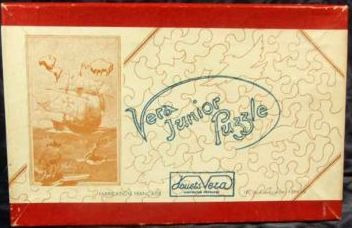
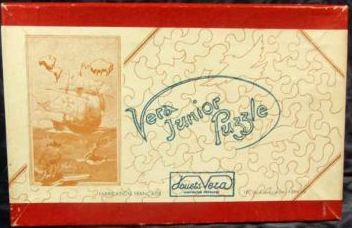
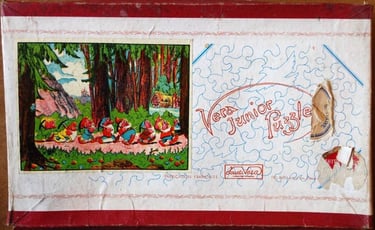
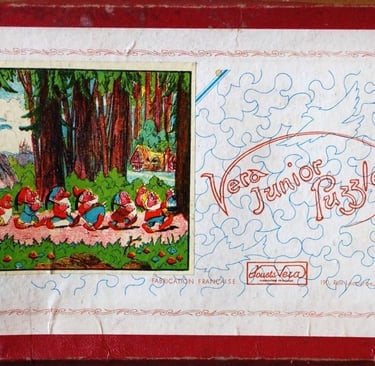
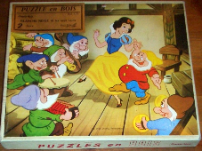
The “Vera Junior Puzzle” range was created to replace the “Vera Puzzle Le Jeu en Vogue” range. The logo is new, with the second bar of the ‘V’ in ‘Vera’ almost completely encircling the other letters. On the lid, an image covers a large part of the surface. The “Jouets Vera – Made in France” logo appears on the label. The themes are either a variety of subjects (neutral label – see 1), or adaptations of Snow White, Perrault’s fairy tales, the Farm-Zoo-Circus trio… (a reproduction of the jigsaw is stuck onto the lid – see 2):
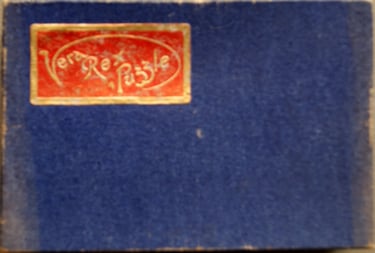
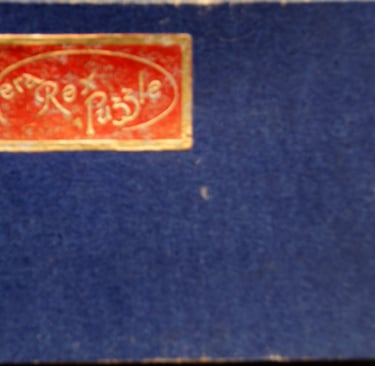
Launch of the “Vera Rex Puzzle” range for adult jigsaw puzzles with a classic cut-out design, replacing the blue boxes from the “Vera Puzzle” range. The box bears a red rectangular label with gold lettering reading “Vera Rex Puzzle”, identical in shape to that of the “Vera Junior Puzzle”. The range comprises boxes containing 200 to 2,000 pieces, and from 1955 onwards, 2,400 pieces.
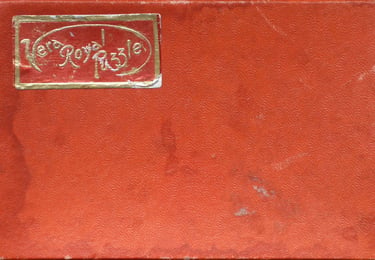
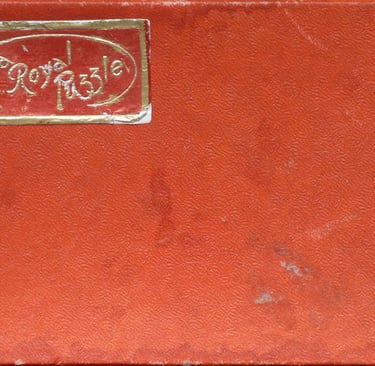
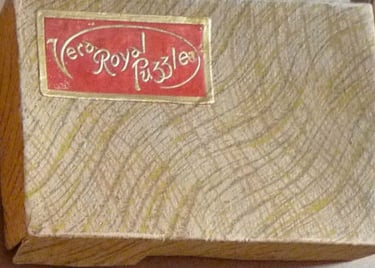
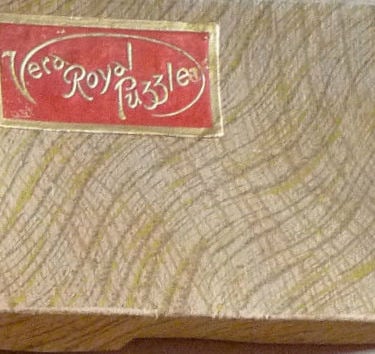
Launch of the “Vera Royal Puzzle” range for adults, again featuring a cut-out design that follows the coloured lines; this replaces the gold boxes of the “Vera Puzzle” and “Vera Picture Puzzle” ranges:
the first boxes were red with a rectangular red label bearing gold lettering reading “Vera Royal Puzzle”, identical in shape to that of the “Vera Junior Puzzle”. The series comprised boxes containing between 200 and 3,000 pieces, then 4,000 pieces around 1955. The earliest versions from this period have a very simple identification label: “Vera Puzzle – Subject: ................ – Number of pieces: approximately ..............”. Some boxes bear the “Velvet Lined” logo, no doubt intended for export sales:
Around 1946–47, some boxes were yellow with wavy stripes; as, to date, only boxes of this colour have been found containing fewer than 150 pages, it is possible that Vera wished to distinguish them for buyers on this basis – to be confirmed:
In 1947, the ‘Jouets Vera – Made in France’ logo appeared on the label on the back of the ‘Vera Rex Puzzle’ and ‘Vera Royal Puzzle’ boxes:
New products are being launched as part of the contract with Kay Kamen (Walt Disney):
Mickey’s Jigsaw Puzzles, featuring a set of seven different boards depicting Mickey and the Three Little Pigs; the packaging comes in different colours but always features decorative motifs:
1948 : 1949 : ou
Dumbo :
Following the Walt Disney collaboration, new commercial agreements were struck:
Around 1946–47 with Germaine Bouret (a famous illustrator of children’s scenes), featuring a range of four different products, each containing 1, 2 or 4 comic strips per box. The contract was likely suspended between 1949 and 1953 for financial reasons
Around 1948, a partnership was formed with Alain Saint-Ogan (creator of Zig and Puce), resulting in a range of three boxes (containing 1, 2 and 6 sheets)
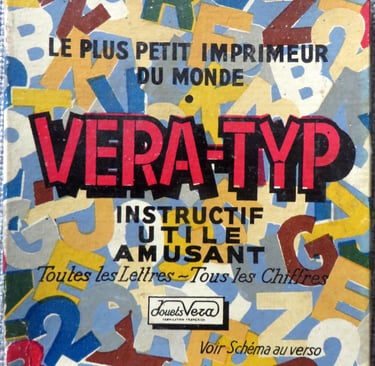
In 1948, Vera launched ‘Vera-Typ’ – the world’s smallest printing press. It consisted of four rubber stamps glued onto the four limbs of a wooden figurine: C, I, - and u, so that all letters and numbers could be produced:
To ensure sufficient business, Vera is also expanding the marketing of complementary games and toys, the manufacture of which is no doubt subcontracted, such as chess sets and children’s tea-set boxes (“Granny’s Breakfast”):
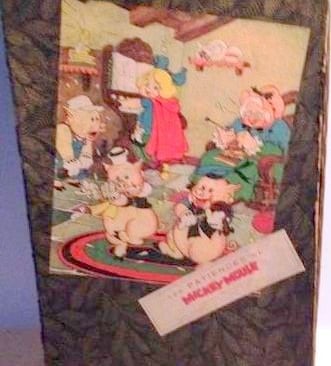
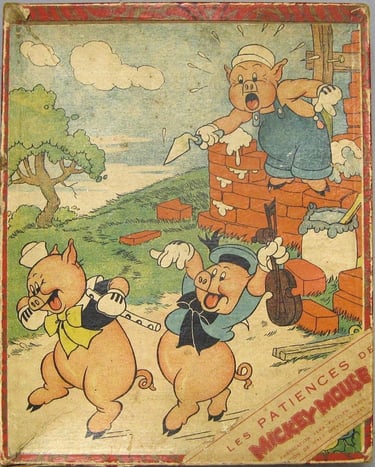
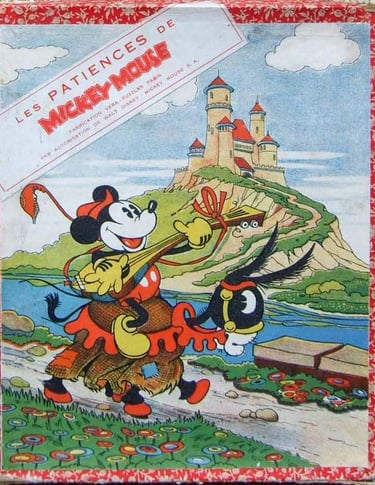
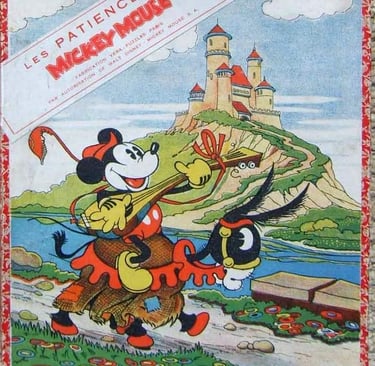
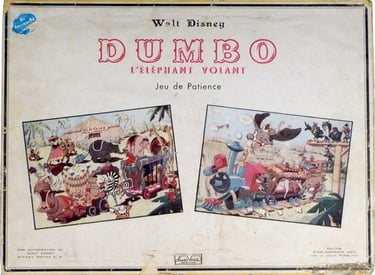
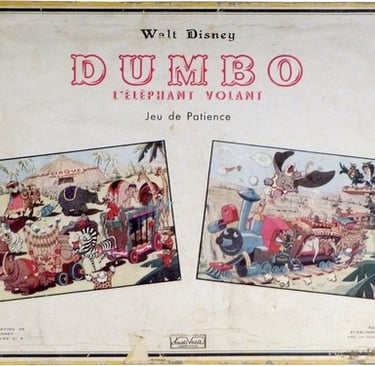

Éléments de photos d'un stand de 1948 - Archives du Musée des Arts Décoratifs
C-5 - 1949-1958 : the revolution
This decade was marked by numerous changes, likely brought about by Robert Tchertoff, who joined the company in 1947.
Financial difficulties linked to the very heavy investment required to create mechanical toys forced the company to terminate its partnership agreements with Germaine Bouret in late 1949 and Alain Saint-Ogan in mid-1950.
In 1949, a reference-based coding system was introduced; No. 1 was a box of two jigsaw puzzles entitled ‘Petites Patiences’. The first series ran from No. 1 to No. 76. The next series (Nos. 77 to 105) was introduced in 1951, and the series (Nos. 110 to 137) in 1953, with the introduction of a banner on single-sheet jigsaw puzzles (see below).
The packaging followed clear standards:
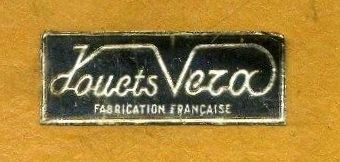
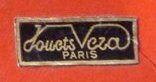
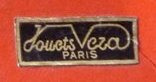
the black ‘Jouets Vera – Paris’ sticker appeared on all products from 1949–50 onwards:
All the logos for the junior and adult jigsaw puzzles take on a definitive round shape with a gold background and the range name inside:
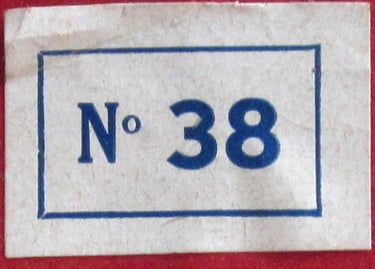
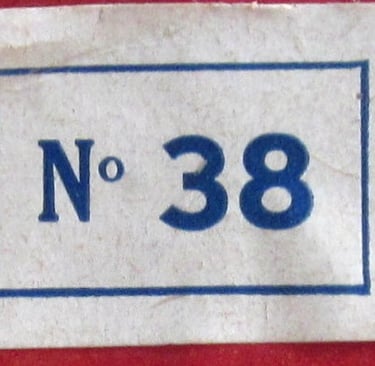
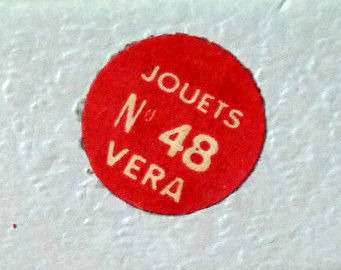
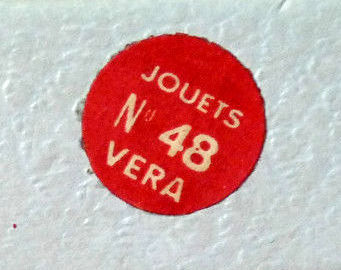
To accompany the introduction of numbering, the jigsaw puzzles are marked with a small rectangular label, which became round and red from 1957 onwards, or by the number being printed on the side of the strip (see below) to enable identification:
1949-50 : - 1957 :
Children’s jigsaw puzzles all feature the same type of packaging:
from 1953 onwards, for boxes containing just one sheet, a photograph covers most of the lid and a white band is added across one corner:
For boxes containing 2, 3 or 6 pieces, the lid features photos of the jigsaw puzzles as well as a label showing the name:
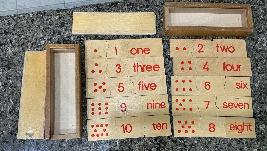
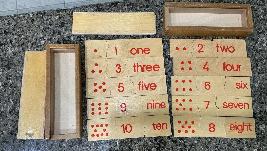
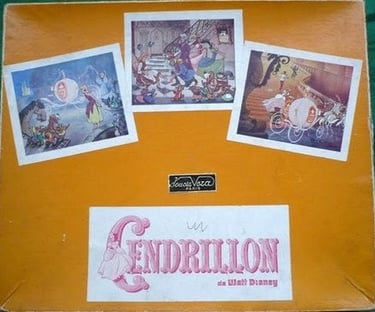
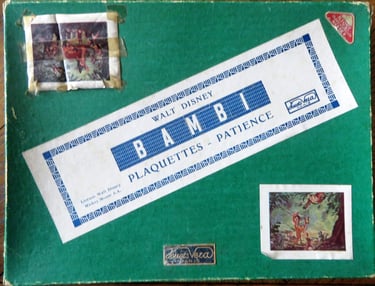
Launch of the “Plaquettes – Patience” range: games consisting of double-sided square tiles, 10 mm thick and 5 cm on each side. Seven sets were launched: five containing 12 tiles (Mickey Mouse No. 61, The Three Little Pigs No. 62, Snow White No. 63, Bambi No. 64 and Pinocchio No. 65), and 2 sets of 24 tiles (Dumbo No. 66 and The Zoo – The Circus No. 67):
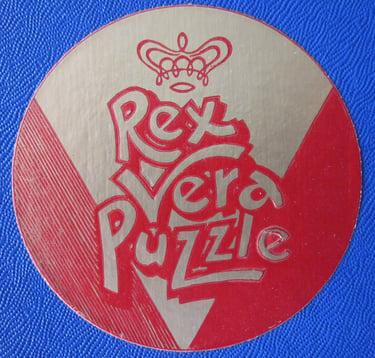
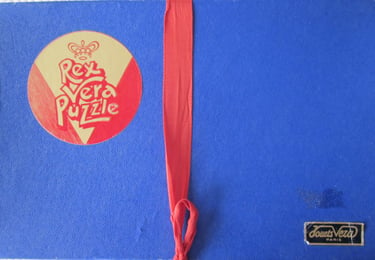
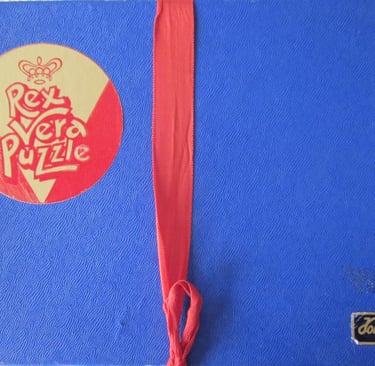
Launch of the “Rex Vera Puzzle” range (No. 30) in 1949: blue box, red ribbon, black “Jouets Vera – Paris” logo affixed to the bottom right of the lid. Around 1955, a new technique developed by “Nana”, one of Vera’s cutters, was used for this range. This new technique involved cutting out the four parts of a sheet – which had previously been cut into four sections – simultaneously; the same piece shape thus appeared in four different places, which could make assembly considerably more difficult if the areas were of a similar colour (sky blue, for example). The main advantage of this new technique is that it reduces manufacturing costs by eliminating the need for sorting. The cutting is carried out across four layers, all of which come from the same jigsaw puzzle – it replaces the ‘Vera Rex Puzzle’ range:
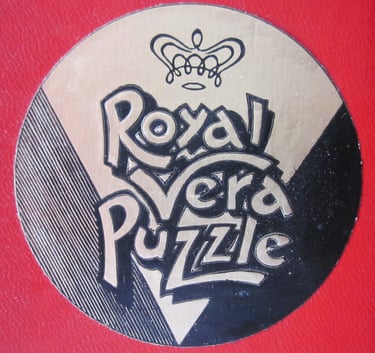
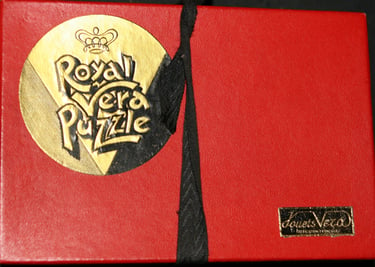
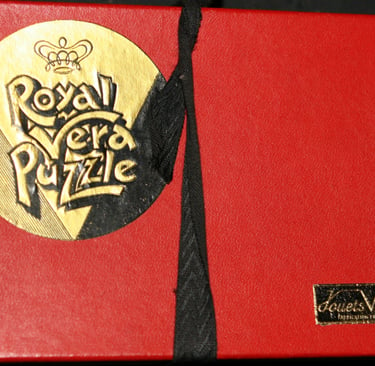
Also in 1949, the “Royal Vera Puzzle” range (No. 31) was launched, featuring the same logo design, the red box and the black ribbon, with the black “Jouets Vera – Paris” logo affixed to the bottom right of the lid; it replaced the “Vera Royal Puzzle” range:
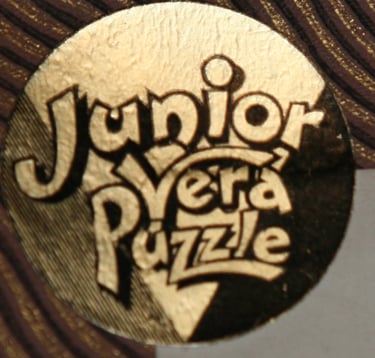
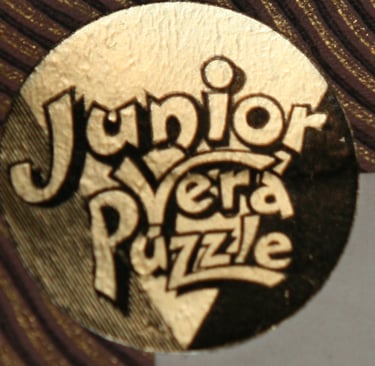
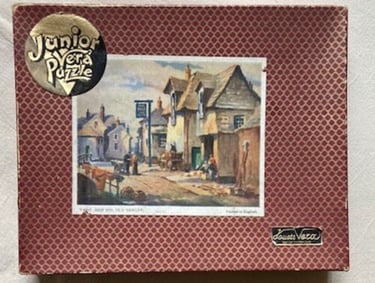
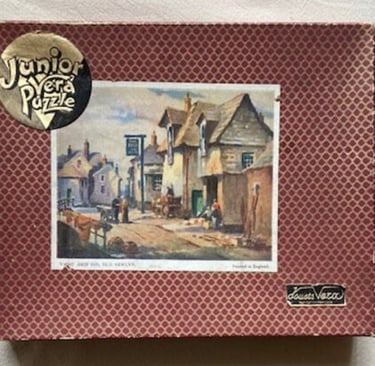
Launch of the “Junior Vera Puzzle” range (No. 29) in 1949: a two-tone box with wavy lines, no ribbon, and a black “Jouets Vera – Paris” logo stuck at the bottom centre of the lid. In addition, the image of the jigsaw is stuck onto the top of the box – a round, gold sticker bearing the words “Junior Vera Puzzle” is affixed there – replacing the “Vera Junior Puzzle” range:
For the adult ranges, apart from the change in name, the only changes to the packaging subsequently concerned the identification label. Details are given in the ‘Codification’ chapter
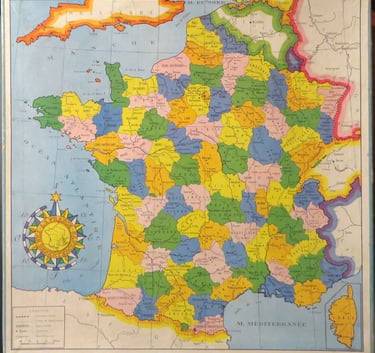
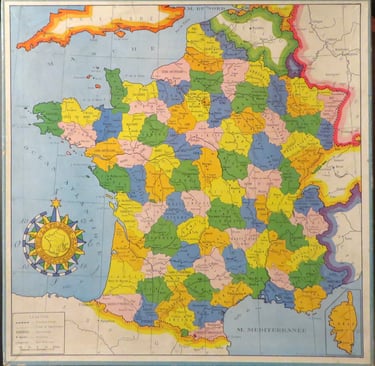
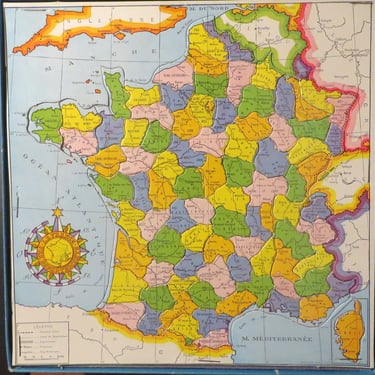
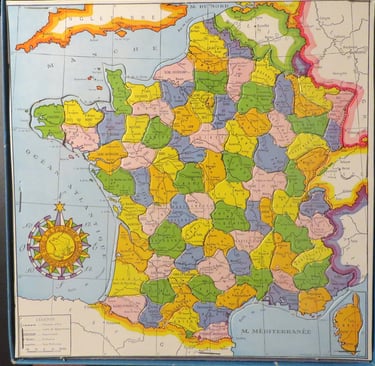
In 1954, Vera made its first attempt to market a cardboard jigsaw puzzle; it was a map of France. It is likely that the manufacture of this jigsaw puzzle was subcontracted:
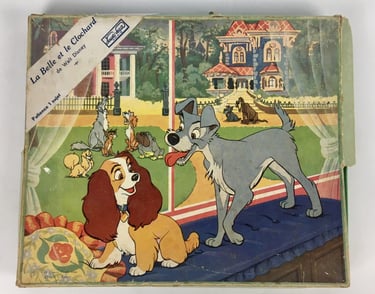
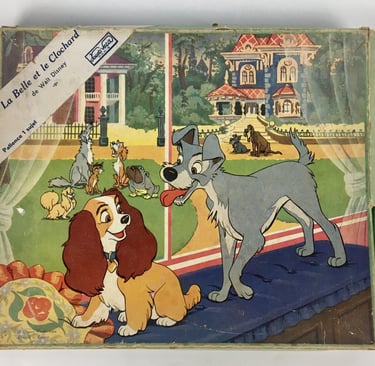
The vast majority of the children’s models are inspired by Walt Disney characters: The Three Caballeros (nos. 77 and 111), Donald and Friends (nos. 78 and 112), Mickey and Friends (nos. 78, 79, 113, 122), Cinderella (nos. 88, 89, 121) , Sleeping Beauty (nos. 90), The Three Little Pigs (nos. 93, 94, 114, 123), Pinocchio (nos. 97, 107 and 120), Snow White (nos. 108 and 115), Bambi (nos. 109 and 116), Dumbo (nos. 110 and 117), Lady and the Tramp (nos. 152 to 154) … Other sources include Perrault’s Fairy Tales (nos. 95, 106 and 118).
In 1955, Vera launched three 6-piece jigsaw puzzles for very young children featuring Mickey, Donald and Bambi (nos. 146 to 148):
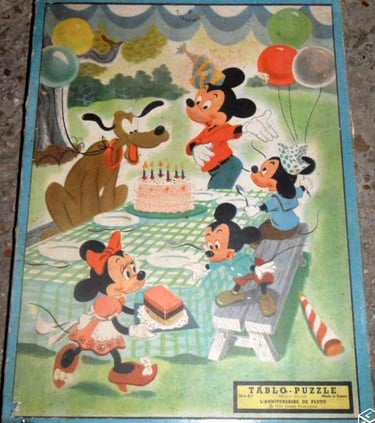
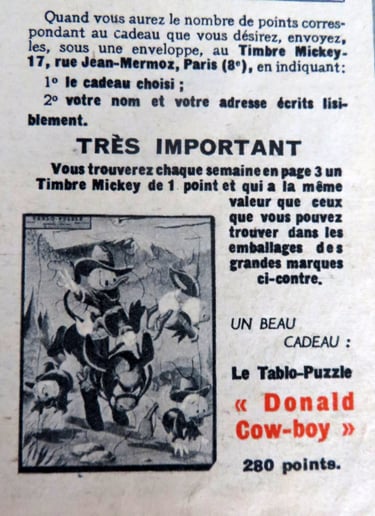
Also in 1955, Vera launched the ‘Tablo-Puzzles’ – these cardboard puzzles were available, amongst other things, in exchange for points earned through the magazine ‘Le Journal de Mickey’:
"Donald Cow-boy" - Tablo-Puzzle - cf. "Le Journal de Mickey" n° 177 sept. 1955 - vu sur Le Bon Coin
Around 1956, the items in the ‘Miniatures’ series returned to being made of wood, with a clear plastic lid. Production of these items ceased around 1960 due to excessively high manufacturing costs:
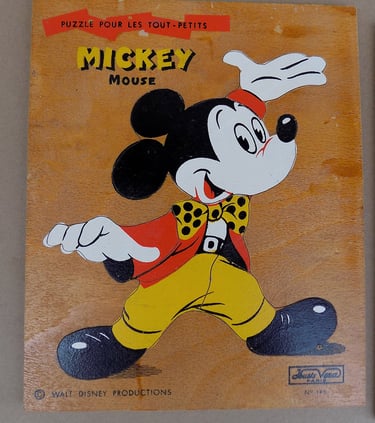
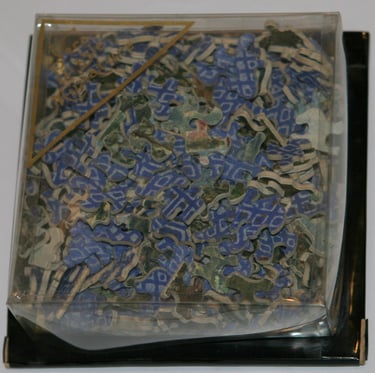
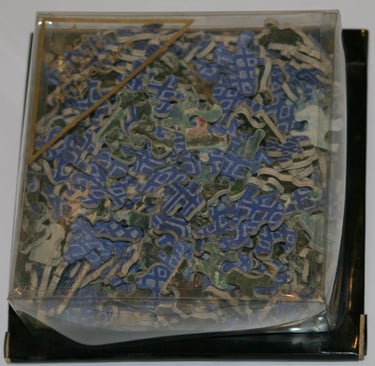
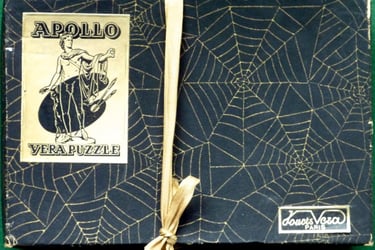
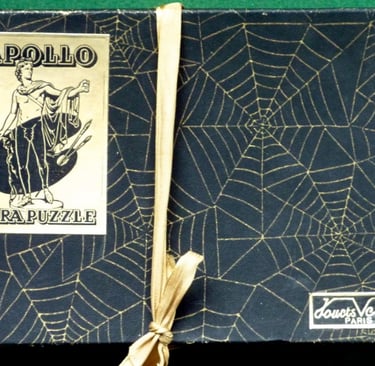
1957: launch of the ‘Apollo Vera Puzzle’ range (No. 166). The cut-out follows the coloured lines, as with the ‘Royal’ series. The “Apollo” boxes are black with gold spider’s web-shaped patterns; the ribbon is yellow. The design on the box lid would undergo numerous changes until the company ceased trading. The “Apollo Vera Puzzle” trademark was registered on 4 January 1957 under No. 461 895:
C-6 - 1958-1967 : product and packaging innovations
The numbering for this period begins with No. 157, the first issue in the ‘Wild and Domestic Animals’ series (see below)
The year 1958 saw a further change to the packaging of all jigsaw puzzles.
Children’s boxes containing just a single sheet were no longer sold individually but in sets of two (double jigsaw – Snow White and Bambi) or three (triple jigsaw – Cinderella, Peter Pan…) wrapped together in clear plastic film.
boxes containing 2, 3 or 6 boards adopted the same type of packaging: the puzzles were displayed on the lid:
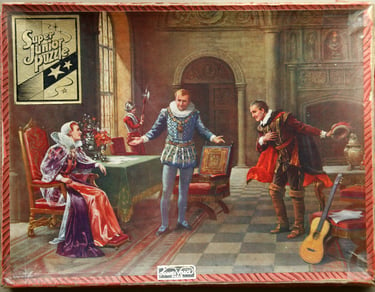
In 1959–60: the ‘Junior’ range was replaced by the ‘Super-Junior Puzzle’ range for children aged 8 to 15. The original number 29 was retained for the first batches, but became No. 185 in 1960:
This period was also marked by significant innovation in diversification efforts, notably with the introduction of new ranges and new brands:
Puzzles under the “Multicolor” brand, which were more challenging than the “Patience” puzzles but less complex than the “Super-Junior” puzzles – ref. nos. 6 to 8
Two further brands were created: “Belvédère” and “Geografia”. The latter was undoubtedly launched for the Italian market – no further information is available – and no examples have been found to date
a “mixed pack” of 8 different boxes under the “Match” brand and number 169. Production of this item ceased in 1961:
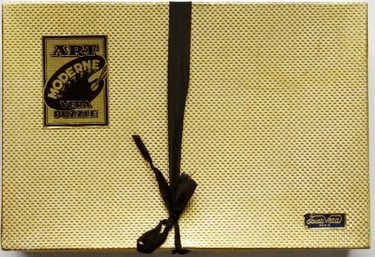
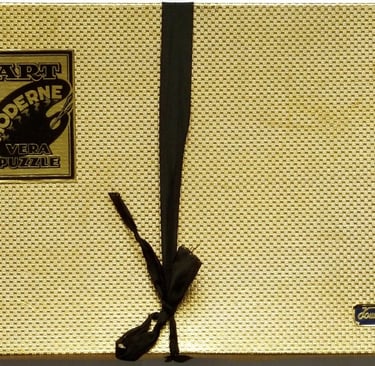
launch of the “Art Moderne” range (No. 196). The cut-outs follow the coloured lines, which makes assembly more difficult, particularly given that the images chosen for this series are mainly modern paintings featuring geometric shapes and reproductions of the most famous Impressionist paintings. The Art Moderne boxes are gold in colour with a black ribbon:
the 10 mm thick wooden ‘Stand Up’ vertical jigsaw puzzles, made in the USA and featuring Walt Disney characters – ref. D1 (9×14 box with 1 design) and D1A (31×14 box with all 4 designs);
launch of the “Bambino” range, featuring puzzles with very large pieces and colours that are easy to match (nos. 205, 207 and 208); the range also includes boxes of 12 giant 60 mm cubes (no. 212):
The first jigsaw puzzles directly linked to everyday life began to appear: the triumphant arrival of the ocean liner “France” in New York Bay on 8 February 1962 led to an agreement with the Compagnie Générale Transatlantique for a series of two jigsaw puzzles featuring the “France” (nos. 209 and 210)
New marketing agreements were signed, notably in 1958 with the illustrator Rojan – puzzles and cubes nos. 158 to 164 depicting wild and domestic animals
New themes were introduced:
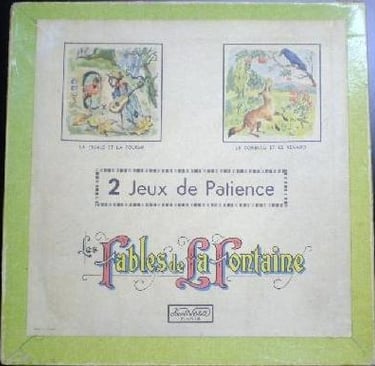
La Fontaine’s Fables made their debut under reference numbers 173 to 176:
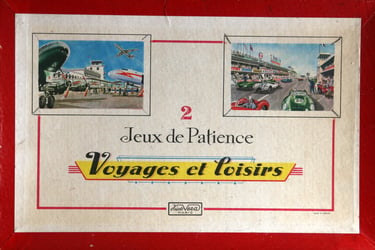
Everyday topics are covered in the ‘Travel and Leisure’ series, under reference numbers 178 to 182:
Television, now found in most homes, is introducing children to new heroes; agreements have been signed with
Jean Image, the television producer (RTF then ORTF), for the series “The Adventures of Joe the Bee” (nos. 230–232) in 1962 and “Aladdin and the Wonderful Lamp” (nos. 327–329) in 1970
Serge Danot, the director and screenwriter of “Le Manège Enchanté” (issues 256 and 257) in 1965
Georges Croses, the creator of the series “Hector's House" - "La Maison de Toutou” (issues 277 and 278) in 1967
Claude Laydu, the creator and director of “Good night, Little Ones" - "Bonne Nuit les Petits” (issues 253 and 254) in 1964
The success of the comic strips led Vera to strike deals with
René Goscinny, Albert Uderzo and Dargaud for two jigsaw puzzles based on the adventures of “Astérix” (nos. 236 and 237) in 1965–66
Pierre Probst and Hachette for “Les Aventures de Caroline” (nos. 282 to 284) in 1968
Jean de Brunhoff and Télé-Hachette for “Babar” (nos. 289, 291, 293 and 296) in 1969
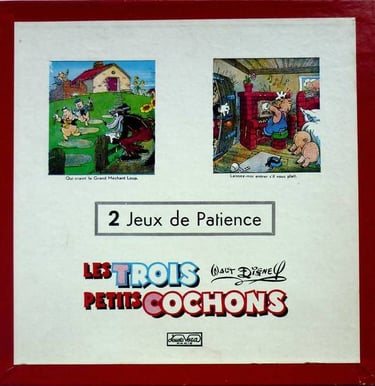
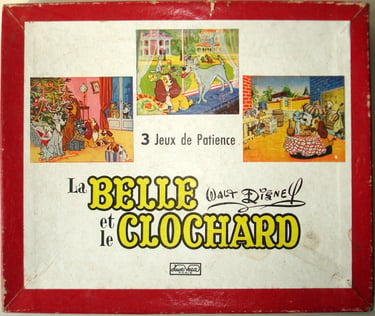
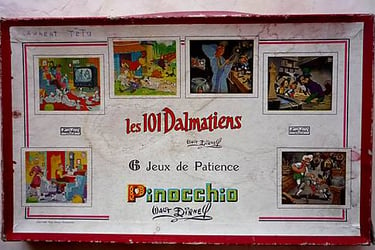
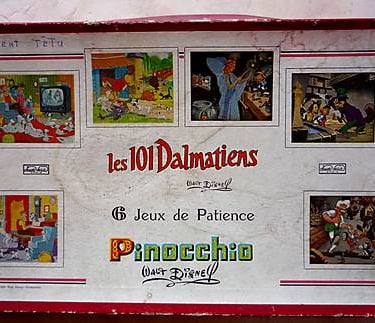
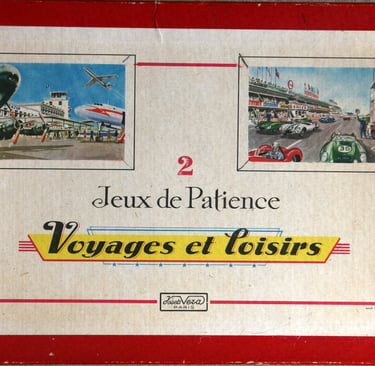
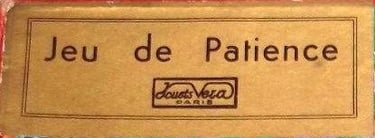
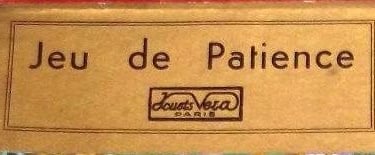
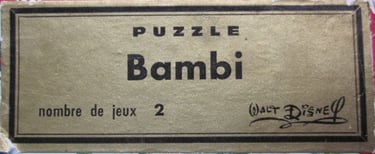
From 1963 onwards, Vera used a “Jeu de Patience” label to describe its jigsaw puzzles – two successive versions:
1963 : - 1967 :
Around 1964–65, Vera began marketing ‘Tower Press’ cardboard jigsaw puzzles from the UK.
Around 1965, the “Le Puzzle qui Chante” series was launched – several models comprising 2 or 4 puzzles, each containing a matching record (ref. nos. 224, 264 to 266, then 296 in 1969).
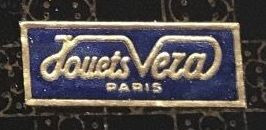
In 1964, the “Jouets Vera – Paris” logo was updated and modernised with a more contemporary typeface and a dark blue background – furthermore, the “era” part of the logo was slightly taller than in the previous version:
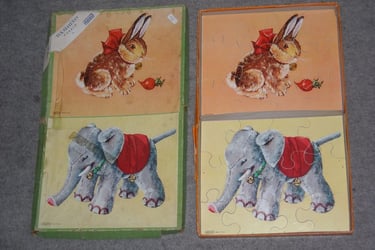
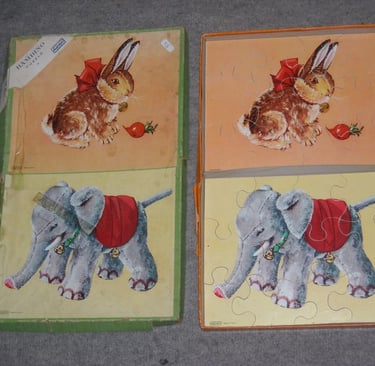
C-7 - 1967-1977 : Robert Tchertoff era
Robert Tchertoff set the company on a new course with a complete overhaul of its packaging and the introduction of new products:
In 1967, a new ‘Jouets Vera – Paris’ logo appeared across the entire range for children and teenagers:
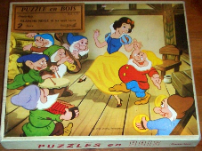
In the same year, the packaging for the “Super-Junior Puzzle” range and all children’s jigsaw puzzles was updated to feature a red background, a white “Jouets Vera” logo running continuously across the diagonal, and numbering in the form of gold dots. The design changed: the J and the V were no longer connected by a horizontal line at the top. This new packaging was unveiled for the first time at the Lyon International Toy Fair in 1967. It was phased in gradually (presumably to make use of existing stock):
Children’s jigsaw puzzles feature a simple label with black lettering on a gold background reading ‘Jigsaw Puzzle – Title – number of pieces/cubes… – logo (e.g. Walt Disney)’:
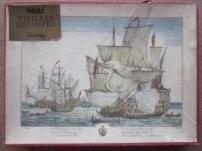
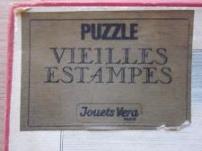
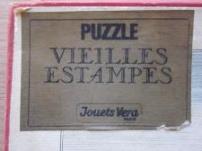
1969: Under catalogue number 295, Vera launched a series of 13 old prints under the title ‘Vieilles Estampes’:
1970: launch of two new products and a change of logo:
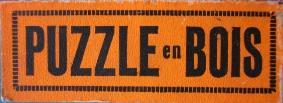
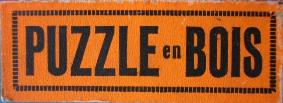
New product under the name ‘PUZZLE en BOIS’ – Title – number of pieces/cubes… – possible logo (Walt Disney-style):
Launch of a series of puzzles made from thick cardboard (nos. 317 to 329) featuring the same label as the one introduced in 1965. The creation of this range thus justifies the use of the ‘WOODEN PUZZLE’ label on those that are still made of wood:
Around 1973 – launch of the ‘Panorama’ jigsaw puzzles featuring photographs of various sites and towns:
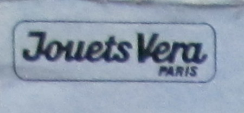
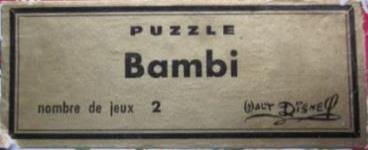
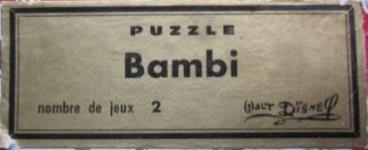
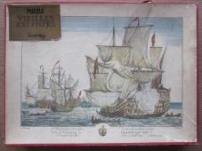
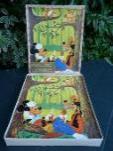
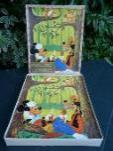
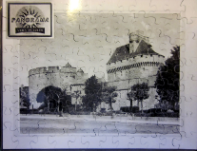
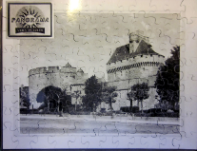
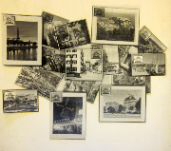
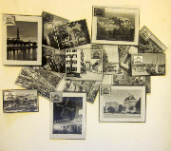
Photos extraites des archives Vera - Centre de Documentation des musées des Arts Décoratifs - Paris
Around 1974: launch of:
launch of new white packaging featuring a wooden jigsaw puzzle on the edge of the lid:
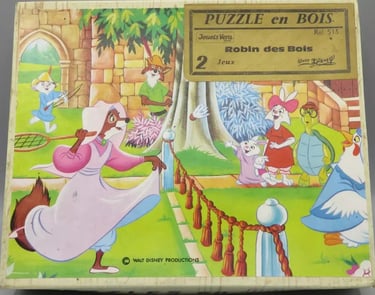
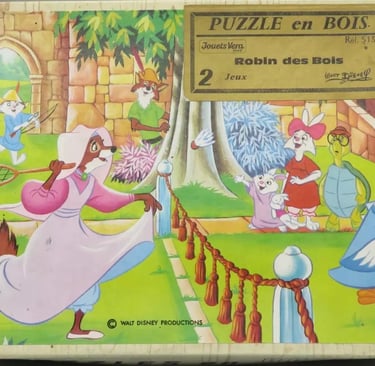
Launch of the Robin Hood series:
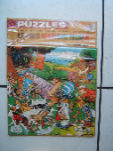
launch of a new range of jigsaw puzzles called ‘Le Bois Matière Noble’; the jigsaw puzzle is wrapped in plastic film:
C-8 - 1977-1980 : Mettoy years
A 1979 price list includes the brands of jigsaw puzzles for adults (Rex, Royal, Apollo and Art Moderne) but also reflects the collapse in the production of children’s puzzles; in fact, only eight items remain:
4 children’s jigsaw puzzles (nos. 330, 404, 42 and 520)
4 sets of Walt Disney wooden building blocks manufactured in England or the USA
The company also sells products made by other firms:
Steinmeier: interlocking games and jigsaw puzzles. Steinmeier BV is a family-run business founded in 1947 in Waalre, the Netherlands. It produced the first wooden jigsaw puzzles with buttons in the 1950s. In the 1970s, the factory was sold to Fisher-Price. Steinmeier BV continued to operate, and its product range expanded from items made solely of wood to a wide variety of materials such as pewter, cardboard, plastic and textiles. Source: https://www.steinmeier.nl
Scad : French manufacturer of moulds for making your own pewter figurines – see & Toys.
Beads and plastic products under the Plasticine and Plastone brands
As regards Mettoy, here is some information about this period:
Despite the headwinds, Mettoy’s sales remained strong throughout the 1970s, and the company posted its highest profit — 3.5 million pounds sterling — in 1978. This was its swan song.
In 1979–80, sales declined steadily and profits plummeted. Mettoy suffered from persistent financial problems, forcing it to sell the majority of its stake in Dragon Data in September 1982. By the end of 1982, its debts stood at 10.5 million pounds.
In September 1983, Mettoy was unable to contribute to a £2.5 million rescue plan. The firm Deloitte, Haskins and Sells was appointed as liquidators.
Sources : Wikipedia, Worldofdragon, Nosher, eBay, Etsy